
Abstract#
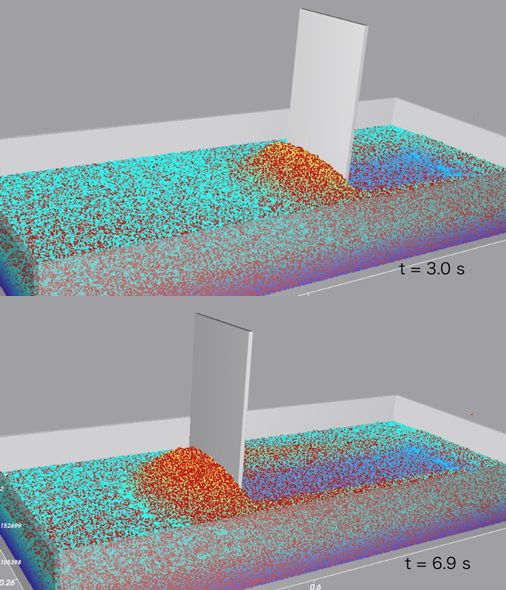
Sediment accumulation at the bottom of dams causes a significant threat to flood control. While underwater bulldozers offer an efficient solution for sediment removal, optimizing the bulldozer blade design is critical to improving operational efficiency. High-fidelity simulation technique is of particular approach for analyzing the blade-soil interaction; however, Discrete Element Method (DEM) simulations alone fail to simultaneously capture the fluid-like behavior and resistance of oversaturated soils. The primary objective of this study is to establish a high-fidelity simulation environment by calibrating a coupled DEM-SPH (Smoothed Particle Hydrodynamics) framework against experimental bulldozing resistance time-histories. In this study, four different calibration approaches—introducing adhesive force model, applying particle size distribution, considering density scaling, and carefully calibrating SPH parameters—were implemented and evaluated. The calibration results verified that adjusting fluid viscosity and surface tension of SPH provided the most robust solution, yielding results that closely aligned with experimental data. Furthermore this study investigates the bulldozing characteristics with varied excavation depths and different blade widths. Future work will involve constructing a reduced-order model of blade-soil interaction to enable computationally-efficient calculation of bulldozing resistance, facilitating the optimized design of blade shapes for improving operational efficiency.
発表文献
- 国際学会 K. Kondo, G. Ishigami, M. Sato, S. Miyai, and D. Dobashi, “Parameter Calibration of DEM-SPH Simulation for an Analysis of Underwater Excavation,” in 56th Conference of the International Society for Terrain-Vehicle Systems (ISTVS 2026), Pretoria, South Africa, Abstract #2467, 2026.