
Abstract#
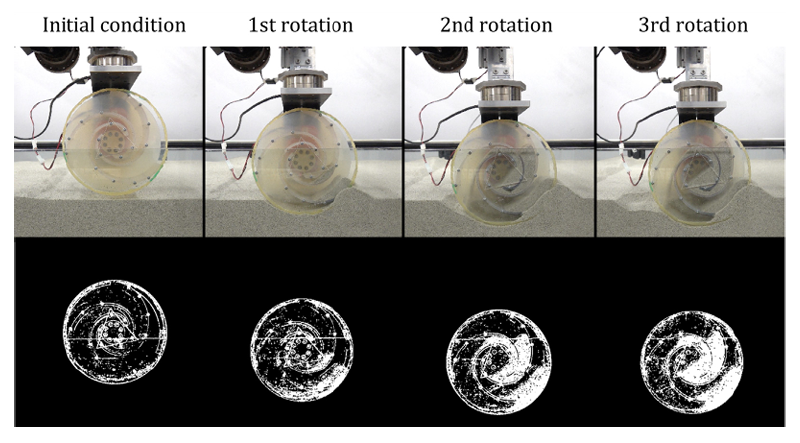
The bucket drum, a cylindrical rotating mechanism that efficiently excavates and collects lunar regolith, is essential for in-situ resource utilization (ISRU). While bucket drums offer advantages in energy efficiency and adaptability to low-gravity conditions, optimizing their shape and motion remains an open issue. Therefore, this paper aims to find an optimal design of the bucket drum using the discrete element method (DEM). We focus on five key design parameters were analyzed: two related to bucket shape (scoop throat length and scoop inlet number) and three related to motion (bucket vertical force, horizontal velocity, and angular velocity). These parameters were evaluated based on two performance indices: sand fill ratio and excavation power consumption. By solving the multi-objective problem of maximizing fill ratio while minimizing power consumption, an optimal design of the bucket drum was identified. Subsequently, a bucket drum with the optimal shape was 3D-printed, and the optimal motion of the bucket drum was applied using the soil excavation test apparatus. The test results qualitatively matched the results derived from the DEM analysis. This highlights the validity of the relationship between the design parameters and two performance indices, contributing to the advancement of ISRU excavation technologies.
Publications
- Journal T. Nakano, T. Omura, R. Galati, and G. Ishigami, “DEM-based analysis and optimization of an excavation bucket drum for in-situ resource utilization,” Journal of Terramechanics, vol. 120, Art. no. 101073, 2025. DOI: 10.1016/j.jterra.2025.101073.
- International Conference T. Nakano, T. Omura, and G. Ishigami, “DEM-Based Analysis and Optimization of an Excavation Bucket Drum for In-Situ Resource Utilization,” in 21st International and 12th Asia-Pacific Regional Conference of the International Society of Terrain Vehicle Systems (ISTVS 2024), Yokohama, Japan, pp. 151–157, 2024. DOI: 10.56884/MPNVS78R.